PhD candidate Polish Academy of Sciences
Viktoriia Muliavka is a PhD student in Sociology at Graduate School for Social Research, Polish Academy of Sciences. In her PhD thesis, she studies regional inequalities in working-class protest participation between Central Eastern and Western Europe. Viktoriia also has been engaged in multiple research project studying institutionalization of political parties in CEE region, environmental politics and political voice and economic inequality in Polish Academy of Sciences and SWPS University of Social Sciences and Humanities.
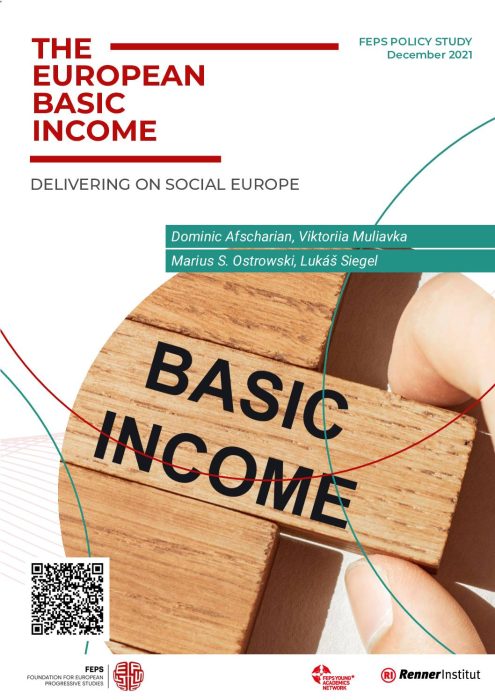
Across the political spectrum, there is widespread agreement that the European Union (EU) needs a palpable social dimension. In this FEPS YAN policy study, the authors provide a research-driven policy proposal on how this social dimension can be achieved in the light of the diversity of national welfare systems in the EU.
They argue that a Universal Basic Income (UBI) could be a conceptually appealing policy to be implemented at EU level, complementing national welfare states. Due to the Covid-19 pandemic, the policy is receiving unprecedented and ever-increasing attention, and enjoys widespread public popularity, but is viewed with scepticism by major political parties.
This paper is a unified source of information for progressive policymakers, advocates, consultants, and researchers who are interested in (a) how a European UBI could be concretely designed and (b) the reasoning and justifications behind its concrete design decisions. In order to formulate a policy proposal that could potentially foster cross- partisan compromises and move public policy preferences and political reality closer together, the authors conducted a comprehensive review of historical and contemporary UBI debates, gathered the key arguments presented in academic, popular, political, and organisational sources, and reflected on them from logical, normative, and empirical perspectives.
Based on the most plausible arguments for and against a UBI, they designed a concrete policy proposal for a UBI at the EU level that responds to broadly progressive ideals from different partisan backgrounds. The result is an ambitious yet feasible proposal that bridges political divides and, if implemented, would be the most substantial leap for Social Europe yet.
Read the paper:
The European Basic Income
Political Mentor: S&D MEP Agnes Jongerius
Academic Mentor: Lorena Lombardozzi, Senior Lecturer in Economics at the Open University.



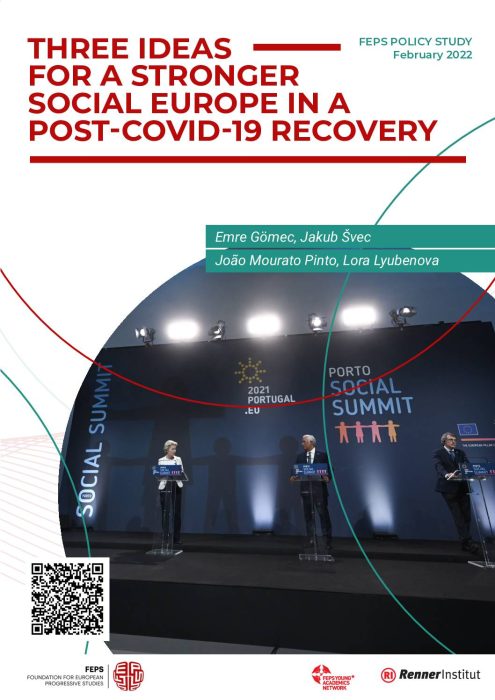

Through its eclectic 20 principles, the European Pillar of Social Rights is an opportunity to break silos and look at social development as the network of challenges that it truly is.
Departing from the rather long history of European social rights, the implementation of the EPSR must follow a holistic approach, identifying synergies with discussions it already hints at in its 20 principles.
In order to contribute to the identification of such synergies, this paper attempts to shed light on three transversal issues that national governments and the European Commission must bear in mind when implementing the EPSR: civil rights; labour relations; and gender equality. The analysis departs from the setting of the current model of welfare state in post-World War II Europe and it ends with the Porto Summit 2021, reflecting on the documents approved and what they can mean for a post-COVID-19 Social Europe.
Read the Paper:
Three ideas for a stronger Social Europe in a post- Covid 19 recovery
Political Mentor: YES Vice President and S&D MEP Alicia Homs
Academic Mentor: Matjaz Nahtigal, Associate professor at the Faculty of Social Sciences, University of Ljubljana