Tijn Croon is a public policy scholar working on the social dimensions of the green transition, with a particular focus on household energy affordability and the distributional impacts of climate policy. His research has been published in journals including Energy Policy, Energy Research & Social Science, and the Journal of Social Policy. He recently joined the European Commission, where he coordinates the Social Climate Fund as a programme manager. Tijn completed a PhD in Public Policy at TU Delft as part of the Marie Skłodowska-Curie project RE-DWELL, and held visiting positions at the University of Cambridge and Columbia University as a Fulbright Scholar. Alongside his academic work, he has been actively engaged in social democratic politics, including as a co-author of the Amsterdam Labour Party’s 2022 municipal election manifesto.
Countries: Netherlands
Lilit Zeltsburg is a researcher and policy advisor with a background in Middle East Studies and Holocaust and Genocide Studies. She conducts research and trains professionals on questions of polarisation, radicalism and extremism. As a policy advisor in the Senate of the Netherlands, she researches and advises senators on social policy, specifically topics such as worker’s rights and housing legislation
This policy study highlights the intersection of gentrification and the rise of the far right in gentrified and contested cities, departing from the observation that the current housing crises play a critical role in the rise of far-right sentiments in urban areas. It explores how broader urban challenges facing the EU are played out at the junction of gentrification, socio-economic inequalities and social fragmentation.
These dynamics have disproportionately impacted marginalised communities by shrinking their spaces of political participation while simultaneously creating fertile ground for support for far-right actors.
To address these issues, the policy study advocates for local, national and European Union level policy interventions aimed at counteracting the adverse effects of gentrification, improving the availability and accessibility of housing, and revitalising communities.
Academic Mentor: Carlo D'Ippoliti, professor of political economy at Sapienza University of Rome
Political Mentor: Irene Tinagli, Member of the European Parliament and Chair of the EP HOUS Sub Commitee
Assistant Professor of Global Energy and Climate Politics in the Institute for Environmental Studies (IVM)
Dr Mathieu Blondeel is Assistant Professor of Global Energy and
Climate Politics in the Institute for Environmental Studies (IVM),
Vrije Universiteit Amsterdam. He specialises in the geopolitics of the
energy transition and the political economy of the oil and gas industry.
Principles and recommendations
In the face of a rapidly evolving geopolitical landscape, marked by global tensions and environmental challenges, this report outlines the evolution of the EU towards a geopolitical union. With the 2024 European elections approaching, the report proposes principles, which, taken together, provide for a dynamic, applicable framework that serves as a basis for practical engagement and policy formulation in fostering a progressive EU geopolitics.
Political Mentor: Andreas Schieder, S&D MEP and Co Chair of Global Progressive Forum
Academic Mentor: Dimitris Tsarouhas. Professor of International Affairs. Global Fellow, The Woodrow Wilson Center for International Scholars
PhD candidate University of Amsterdam
Oscar is a PhD candidate in the Finance Group of the University of Amsterdam. In his research he studies the economics of the European Monetary Union and financial stability implications of central bank digital currency. Other research interests are financial regulation, banking and macro finance.
How to unlock the European Investment Bank’s potential: four reforms
The European Investment Bank (EIB) is the EU’s multilateral development bank. In this FEPS YAN policy study, the authors suggest four reforms that would help progressive policymakers to utilize unlock the EIB’s potential to play a greater role in the EU economy and its transition to a more resilient, climate-neutral, and progressive economy.
First, the authors suggest the EIB adopts more comprehensive lending targets based on social and environmental criteria. Second, they highlight the need for a stronger focus on equity-like instruments rather than debt instruments, especially in the ongoing response to the Covid-19 crisis. Third, they propose to strengthen the EIB’s accountability towards the European Parliament to ensure a legitimate political direction and democratic control of its activities. Fourth, they propose to convert the EIB’s retained profits into paid-in capital, unlocking up to €110 billion of additional lending capacity. To simultaneously accomplish increased democratic accountability, the authors suggest converting the EIB’s retained profits into EU capital and thus making the EU an EIB shareholder.
Read the paper:
How to unlock the European Investment Bank’s potential: four reforms
Political Mentor: EP Vice President and S&D MEP Pedro Silva Pereira
Academic Mentor: Carlo d' Ippoliti, Associate professor of political economy at the Department of Statistical Sciences of Sapienza University of Rome.
Post-doctoral researcher Maastricht University
Alvaro Oleart is a post-doctoral researcher at the at the Faculty of Arts and Social Sciences of Maastricht University, and a scientific collaborator at the Université Libre de Bruxelles. He is the author of the book Framing TTIP in the European public spheres: Towards an Empowering Dissensus for EU integration (2021), published by the series Palgrave Studies in European Political Sociology. His fields of interest are the European public sphere, the role of civil society in the EU policy-making, EU trade policy, populism and democracy in Europe, and the analysis of discourse and narratives.
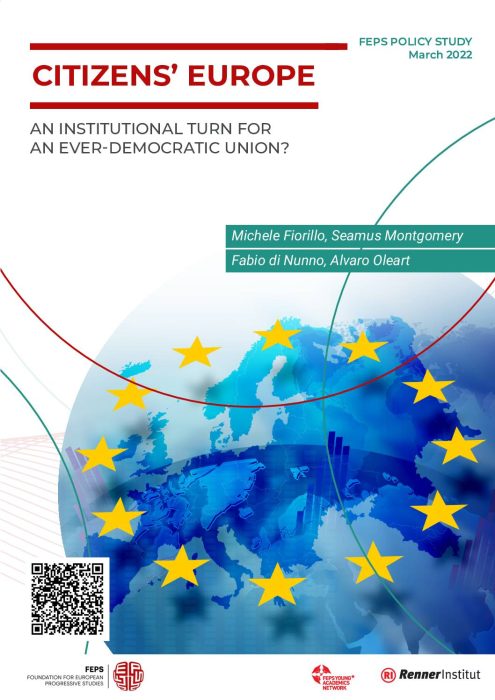
Citizens’ Europe – An institutional turn for an ever-democratic union?
The paper outlines a vision of the ongoing Conference on the Future of Europe (CoFoE) from various perspectives and sets out proposals regarding how it should develop in order to contribute to making the EU more democratic. First, the paper discusses further steps the Conference should take towards bridging the gap between EU and national politics.
Second, the paper analyses previous initiatives of treaty reforms which may be incorporated into the Conference on the Future of Europe. Third, the paper lays out the visions of Europe in a half-century’s time among EU Commission officials. Last, the paper discusses citizens’ involvement in shaping EU future through a broader process of European deliberative democracy, and how the CoFoE could advance such a perspective.
Read the paper:
Citizens’ Europe - An institutional turn for an ever-democratic union?
Political Mentor: S&D MEP Domènec Ruiz Devesa
Academic Mentor: Michael Holms, Senior Lecturer in Politics and International Relations at Liverpool Hope University