Tijn Croon is a public policy scholar working on the social dimensions of the green transition, with a particular focus on household energy affordability and the distributional impacts of climate policy. His research has been published in journals including Energy Policy, Energy Research & Social Science, and the Journal of Social Policy. He recently joined the European Commission, where he coordinates the Social Climate Fund as a programme manager. Tijn completed a PhD in Public Policy at TU Delft as part of the Marie Skłodowska-Curie project RE-DWELL, and held visiting positions at the University of Cambridge and Columbia University as a Fulbright Scholar. Alongside his academic work, he has been actively engaged in social democratic politics, including as a co-author of the Amsterdam Labour Party’s 2022 municipal election manifesto.
Countries: Belgium
Davide Martino is currently a Wiener-Anspach Postdoctoral Fellow at the Université Libre de Bruxelles (ULB). Central to his research interests are human-environment interactions, through which both society and nature have been co-constructed, over the last five centuries. His research and teaching are at the crossroads of water and environmental histories, histories of science and technology, and architectural and art histories. Prior to joining the ULB, Davide worked as Postdoc in architectural history at the Universität Bern (Switzerland). He holds a PhD in History (2023) from St John’s College, University of Cambridge (UK), where he also completed an MPhil in Early Modern History (2017) and a BA in History (2016). Davide also worked as a teacher in a British state primary school in the past and remains passionate about the role of education in society.
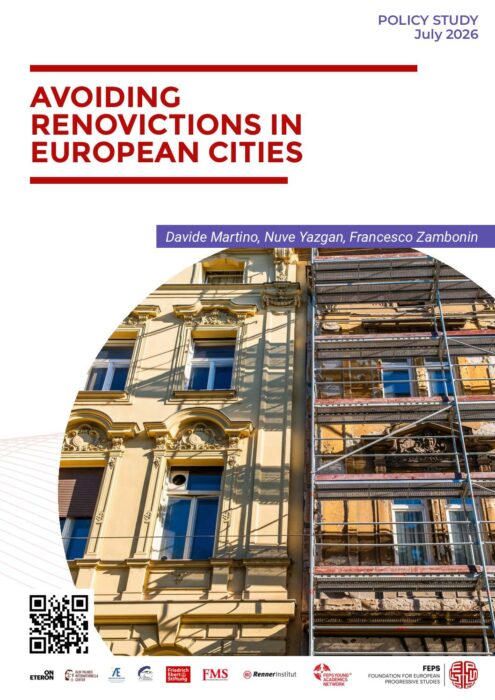
Europe faces a dual challenge: the climate crisis and a persistent housing crisis, both of which converge in the urgent need to renovate aging urban housing stock. While energy-efficient renovations are essential to meet EU carbon-neutrality targets by 2050, they risk triggering “renovictions”, the displacement of vulnerable residents due to rising rents and property values. This policy study shows how these renovictions can be avoided.
This policy study summarise the scientific literature and survey best practices and cautionary tales from three cities across Europe: Amsterdam; Athens; and Paris. These are three large capitals, with historic centres protected by heritage status and facing the pressure of (over)tourism.
Academic Mentor: Eunice Goes, Professor of Politics at Richmond University in London
Political Mentor: Andreas Schieder, Member of the European Parliament and S&D Coordinator of HOUS Sub Committee
Alessandro Marcia (He/Him) is a Ph.D. Researcher and Lecturer of EU law at Maastricht University. His research focuses on LGBTIQA+ rights’ protection under EU law. Alessandro holds a Master’s Degree in Law from the University of Bologna and an LL.M. in EU law from Université libre de Bruxelles. Before joining UM, he served as a Lecturer of EU law at the China – EU School of Law, based at the University of Hamburg. Alessandro is also an activist for European integration and LGBTIQA+ rights. He is a member of the Global LGBTQI+ Changemakers Network established by the Carr-Ryan Center for Human Rights at Harvard University. He also runs the newsletter Europe and LGBTIQA+ Rights.
This policy study analyses how the European Parliament (EP) has engaged with the European Commission’s Rule of Law Reports (RoLRs) during the ninth legislative term (2019-2024). It also examines what this engagement reveals about the EP’s understanding of the rule of law and its capacity to strengthen EU-level democratic safeguards.
Drawing on a qualitative analysis of parliamentary resolutions, debates and voting patterns, the policy study examines whether the EP approaches the rule of law primarily as a procedural-legal standard or as a broader normative principle encompassing fundamental rights, equality and democratic inclusion.
Academic Mentor: Felix Butzlaff, political scientist and postdoctoral fellow at the Central European University Vienna
Political Mentor: Juan Fernando López Aguilar, S&D Coordinator LIBE Committee
Joint PhD at the University of Edinburgh and KU Leuven
Christos Papagiannis is a PhD researcher at Maastricht University,
focusing on the political economy of artificial intelligence in the
European Union. He holds a Master of Public Administration from
the London School of Economics and an MSc in Marketing and
Communication with International Orientation from the Athens
University of Economics and Business. He has collaborated as a
research assistant and public affairs consultant with King’s College
London’s Centre for Data Futures and has served as a visiting
researcher at the LSE–Canada Blanch Centre. He previously served as
Director of the Eteron Institute and as a researcher for DPA/Infocom,
the research branch of the German Press Agency, and currently serves
as Secretary General of the Young European Federalists (JEF Europe).
The increasing spread of misinformation has become a significant challenge to the implementation and public reception of EU policies, particularly in climate-related areas. This policy study explores the intersection of misinformation and policy communication, focusing on the Common Agricultural Policy.
The study aims to investigate how misinformation shapes public perceptions and resistance to climate policies and to develop strategic recommendations for more effective policy communication. Utilising case study analysis, the research will provide actionable insights for EU policymakers.
Political Mentor: Alex Agius Saliba, Member of the European Parliament and Vice President of S&D Group
After a short experience in the banking sector, both private and central bank, he returned to academia to pursue research. He holds a Master of Research in Economics from Sciences Po Paris and he is currently a fourth-year PhD candidate in Economics at KU Leuven, Belgium. His work lies in Political Economy. He mainly studies how socio-economic factors shape electoral dynamics, including support for extremist parties, and how Italian organized crime influences political selection and outcomes. His research combines quantitative analysis of recent electoral behaviour in Belgium with a long-run historical perspective on Italy.
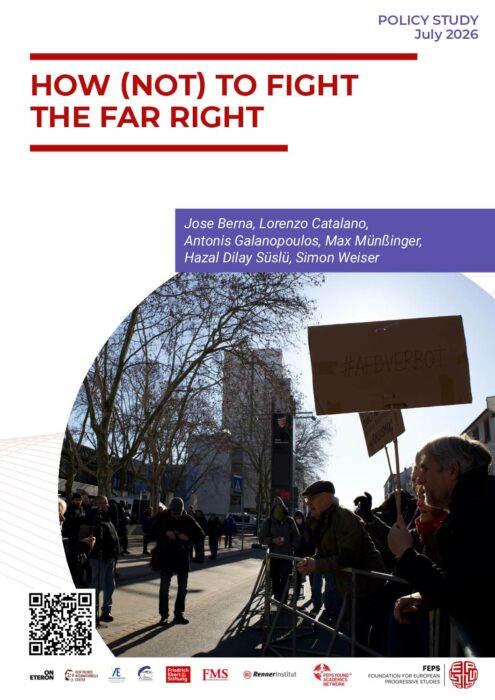
This policy study investigates the strategies employed by European social democratic parties in response to the rise of far-right political parties since the 2010s. By building on well over 100 academic studies, we draw clear strategic implications for progressive actors facing far-right competition.
After looking at scientific research on how to fight the far right, a minimum of three strategic orientations emerge:
1) Social democrats must systematically understand why far-right narratives resonate – examining social grievances, emotions and discursive strategies – without adopting far-right frames.
2) They must reclaim agenda-setting power by foregrounding areas of long-standing credibility – notably, welfare, redistribution and economic justice – and by refusing debates imposed on far-right terms.
3) Social democrats need a positive, forward-looking vision that combines an inclusive collective identity with a credible agenda for economic equality, reconnecting policy with collective emotions.
Read the Policy Study
Academic Mentor: Daphne Halikiopoulou, Professor of Comparative Politics at University of Reading
Political Mentor: Mathias Ecke, S&D MEP of the European Parliament
Assistant Professor of Global Energy and Climate Politics in the Institute for Environmental Studies (IVM)
Dr Mathieu Blondeel is Assistant Professor of Global Energy and
Climate Politics in the Institute for Environmental Studies (IVM),
Vrije Universiteit Amsterdam. He specialises in the geopolitics of the
energy transition and the political economy of the oil and gas industry.
Principles and recommendations
In the face of a rapidly evolving geopolitical landscape, marked by global tensions and environmental challenges, this report outlines the evolution of the EU towards a geopolitical union. With the 2024 European elections approaching, the report proposes principles, which, taken together, provide for a dynamic, applicable framework that serves as a basis for practical engagement and policy formulation in fostering a progressive EU geopolitics.
Political Mentor: Andreas Schieder, S&D MEP and Co Chair of Global Progressive Forum
Academic Mentor: Dimitris Tsarouhas. Professor of International Affairs. Global Fellow, The Woodrow Wilson Center for International Scholars
Joint PhD at the University of Edinburgh and KU Leuven
Unai Gómez-Hernández is a joint PhD at the University of Edinburgh and KU Leuven. His work focuses on how European radical right populist parties influence the EU’s external action vis-à-vis China. He is member of the EPRG and LINES research groups at Edinburgh and Leuven, respectively. His broader research interests deal with political parties, European external action, EU-China relations, and the Liberal International Order. Before embarking upon the PhD journey, he worked in the private sector, for the Basque Environmental Cluster in Bilbao, and in the public sector, as an advisor to the Delegate of the Basque Country in Brussels. He holds a BSc in Political Science (University of the Basque Country), BSc in International Relations (London School of Economics and Political Science), and a MA in International Relations and Diplomacy of the EU (College of Europe, Bruges Campus). On his free time, Unai enjoys reading, debating politics with friends, and playing League of Legends.
In recent years, European citizens have witnessed a rise in inequality, especially socio-economic, alongside an increase in vote share for radical right populist parties. By examining case studies from Italy, Hungary, and Spain (with the comparative case of Germany), this policy study argues that the rise of populism is not only linked to economic trends but also to other constitutional changes and institutional settings characterising European countries with a focus on economic inequality as the explanatory variable for political participation.
Political Mentor: Gaby Bischoff, MEP S&D
Academic Mentor: Eunice Goes, Professor of Politics at Richmond American University of London
Joint PhD at the University of Edinburgh and KU Leuven
This policy study analyses how the European Parliament (EP) has engaged with the European Commission’s Rule of Law Reports (RoLRs) during the ninth legislative term (2019-2024). It also examines what this engagement reveals about the EP’s understanding of the rule of law and its capacity to strengthen EU-level democratic safeguards.
Drawing on a qualitative analysis of parliamentary resolutions, debates and voting patterns, the policy study examines whether the EP approaches the rule of law primarily as a procedural-legal standard or as a broader normative principle encompassing fundamental rights, equality and democratic inclusion.
Academic Mentor: Felix Butzlaff, political scientist and postdoctoral fellow at the Central European University Vienna
Political Mentor: Juan Fernando López Aguilar, S&D Coordinator LIBE Committee
Joint PhD at the University of Edinburgh and KU Leuven
Post-doctoral researcher Maastricht University
Alvaro Oleart is a post-doctoral researcher at the at the Faculty of Arts and Social Sciences of Maastricht University, and a scientific collaborator at the Université Libre de Bruxelles. He is the author of the book Framing TTIP in the European public spheres: Towards an Empowering Dissensus for EU integration (2021), published by the series Palgrave Studies in European Political Sociology. His fields of interest are the European public sphere, the role of civil society in the EU policy-making, EU trade policy, populism and democracy in Europe, and the analysis of discourse and narratives.
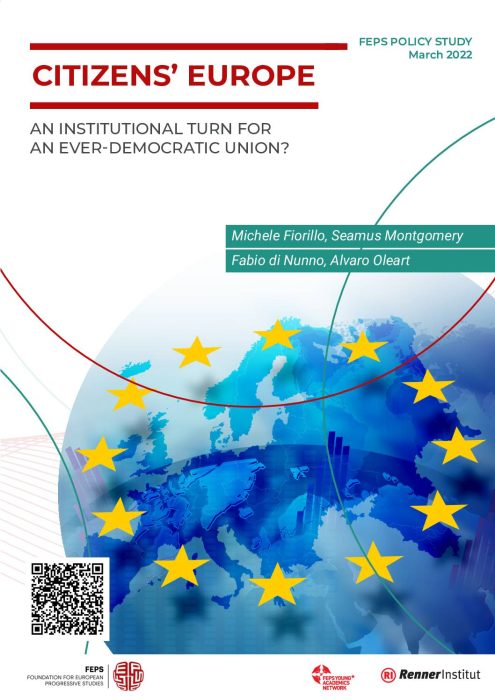
Citizens’ Europe – An institutional turn for an ever-democratic union?
The paper outlines a vision of the ongoing Conference on the Future of Europe (CoFoE) from various perspectives and sets out proposals regarding how it should develop in order to contribute to making the EU more democratic. First, the paper discusses further steps the Conference should take towards bridging the gap between EU and national politics.
Second, the paper analyses previous initiatives of treaty reforms which may be incorporated into the Conference on the Future of Europe. Third, the paper lays out the visions of Europe in a half-century’s time among EU Commission officials. Last, the paper discusses citizens’ involvement in shaping EU future through a broader process of European deliberative democracy, and how the CoFoE could advance such a perspective.
Read the paper:
Citizens’ Europe - An institutional turn for an ever-democratic union?
Political Mentor: S&D MEP Domènec Ruiz Devesa
Academic Mentor: Michael Holms, Senior Lecturer in Politics and International Relations at Liverpool Hope University