Doctoral researcher in Comparative Politics and a lecturer at the University of Cologne
Interests : Democracy Foreign Affairs
Countries : Germany United Kingdom Turkey

Ece Özbey is a doctoral researcher in Comparative Politics and a lecturer at the University of Cologne, where she is pursuing her PhD on populist contagion and anti-populism in the United Kingdom. Her research spans Euroscepticism, political competition, radicalization, and democracy, with a primary focus on European democracies. She holds an MSc in European Studies and a BSc in International Relations. Ece is also the Co-Managing Editor of the Review of Democracy, the journal of the Central European University’s Democracy Institute, where she previously worked as a Global Forum for Democracy and Development Fellow. She is affiliated with the METU Jean Monnet Centre of Excellence and has published on European integration and EU–Turkey relations. She has also held visiting positions at academic institutions in the United States, the United Kingdom, and Chile and is actively involved in various international research networks, including OPUS Initiative and Team Populism

Publications
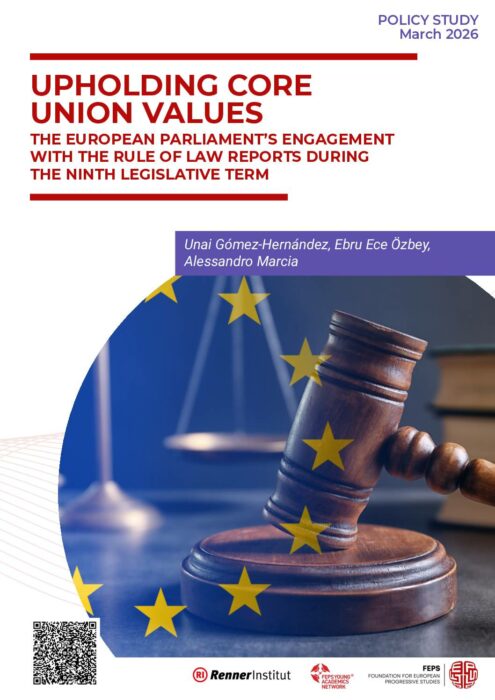
Upholding core Union values. The European Parliament’s engagement with the Rule of Law Reports during the ninth legislative term

This policy study analyses how the European Parliament (EP) has engaged with the European Commission’s Rule of Law Reports (RoLRs) during the ninth legislative term (2019-2024). It also examines what this engagement reveals about the EP’s understanding of the rule of law and its capacity to strengthen EU-level democratic safeguards.

Drawing on a qualitative analysis of parliamentary resolutions, debates and voting patterns, the policy study examines whether the EP approaches the rule of law primarily as a procedural-legal standard or as a broader normative principle encompassing fundamental rights, equality and democratic inclusion.

Read the Policy Study

Academic Mentor: Felix Butzlaff, political scientist and postdoctoral fellow at the Central European University Vienna
Political Mentor: Juan Fernando López Aguilar, S&D Coordinator LIBE Committee

Members
Ph.D. Researcher and Lecturer of EU law at Maastricht University
Interests : Democracy Gender Equality
Countries : Belgium Italy
Doctoral researcher in Comparative Politics and a lecturer at the University of Cologne
Interests : Democracy Foreign Affairs
Countries : Germany United Kingdom Turkey

Joint PhD at the University of Edinburgh and KU Leuven
Interests : Democracy Foreign Affairs Inequality
Countries : Belgium Spain United Kingdom
Publications
17/03/2026

Upholding core Union values. The European Parliament's engagement with the Rule of Law Reports during the ninth legislative term

FEPS YAN papers 9th Cycle
PhD Candidate University of Surrey
Interests : Democracy EU external relations
Countries : United Kingdom Turkey

Dilay holds degrees in Economics and Political Science, as well as an MSc in Political Science and Public Administration from the Middle East Technical University (METU), Turkey. She is currently pursuing her PhD in the UK, where she also holds Associate Fellowship at the Higher Education Academy (AFHEA). Before starting her doctoral studies at the University of Surrey’s Department of Politics, Dilay gained professional experience in both academia and the civil society sector, working as an academic assistant and an NGO officer. Her interdisciplinary background in economics, political science, and cultural studies shapes her current research, which examines how Populist Radical Right Parties (PRRPs) impact mainstream political parties’ positions on gender-related issues.

Publications
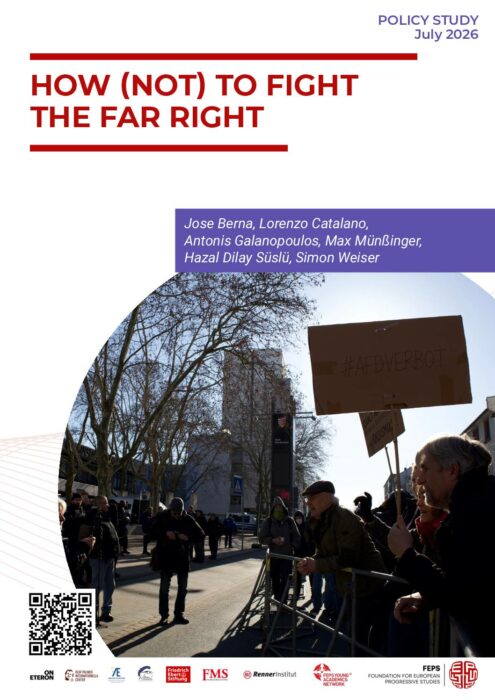
How (not) to fight the far right

This policy study investigates the strategies employed by European social democratic parties in response to the rise of far-right political parties since the 2010s. By building on well over 100 academic studies, we draw clear strategic implications for progressive actors facing far-right competition. 

After looking at scientific research on how to fight the far right, a minimum of three strategic orientations emerge:
1)         Social democrats must systematically understand why far-right narratives resonate – examining social grievances, emotions and discursive strategies – without adopting far-right frames.
2)         They must reclaim agenda-setting power by foregrounding areas of long-standing credibility – notably, welfare, redistribution and economic justice – and by refusing debates imposed on far-right terms.
3)         Social democrats need a positive, forward-looking vision that combines an inclusive collective identity with a credible agenda for economic equality, reconnecting policy with collective emotions.

Read the Policy Study

Academic Mentor: Daphne Halikiopoulou, Professor of Comparative Politics at University of Reading
Political Mentor: Mathias Ecke, S&D MEP of the European Parliament

Members
PhD in Political Science from Aristotle University of Thessaloniki. Political researcher at Eteron
Interests : Democracy Policy
Countries : Greece
PhD Candidate University of Surrey
Interests : Democracy EU external relations
Countries : United Kingdom Turkey
PhD in Media, Communication and Culture at the Universitat Autònoma de Barcelona
Interests : Democracy Policy
Countries : Spain
PhD candidate in Economics at KU Leuven
Interests : Economy Democracy
Countries : Belgium Italy
Research associate and PhD candidate at FAU Erlangen-Nuremberg
Interests : Democracy Policy
Countries : Germany
PhD candidate at Ludwig-Maximilians-University Munich
Interests : Democracy Foreign Affairs
Countries : Germany
Publications
22/07/2026

How (not) to fight the far right

FEPS YAN papers 9th cycle

PhD candidate University of Kassel 

Interests : Economy Digital Social Europe
Countries : Germany Turkey

Emre Gömeç is a Ph.D. candidate at the University of Kassel and a Ph.D. fellow of Hans Böckler Foundation in Germany. Also, he is a researcher at The Academic-Industry Research Network (theAIRnet) in the United States. His research fields are financialization, corporate governance, and innovation as well as the Information and Communication Technologies (ICT) sector. He compares the corporate governance models of two telecommunication companies, Nokia and Ericsson, as a case study in his dissertation.

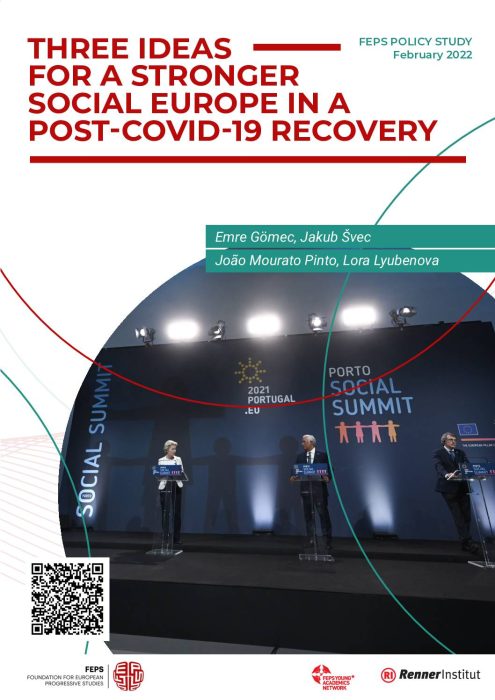
Three ideas for a stronger Social Europe in a post-COVID-19 recovery

Publications
Social Europe

Through its eclectic 20 principles, the European Pillar of Social Rights is an opportunity to break silos and look at social development as the network of challenges that it truly is.

Departing from the rather long history of European social rights, the implementation of the EPSR must follow a holistic approach, identifying synergies with discussions it already hints at in its 20 principles.

In order to contribute to the identification of such synergies, this paper attempts to shed light on three transversal issues that national governments and the European Commission must bear in mind when implementing the EPSR: civil rights; labour relations; and gender equality. The analysis departs from the setting of the current model of welfare state in post-World War II Europe and it ends with the Porto Summit 2021, reflecting on the documents approved and what they can mean for a post-COVID-19 Social Europe.

Read the Paper:
Three ideas for a stronger Social Europe in a post- Covid 19 recovery

Political Mentor: YES Vice President and S&D MEP Alicia Homs
Academic Mentor: Matjaz Nahtigal, Associate professor at the Faculty of Social Sciences, University of Ljubljana

Members
Publications
15/02/2022

Three ideas for a stronger Social Europe in a post- Covid 19 recovery

FEPS YAN
23/04/2018

Global Challenges and their impact in the Middle East

09/10/2014

Nine Suggested Principles to Guide EU-US Collaboration on financial regulatory reform