After a short experience in the banking sector, both private and central bank, he returned to academia to pursue research. He holds a Master of Research in Economics from Sciences Po Paris and he is currently a fourth-year PhD candidate in Economics at KU Leuven, Belgium. His work lies in Political Economy. He mainly studies how socio-economic factors shape electoral dynamics, including support for extremist parties, and how Italian organized crime influences political selection and outcomes. His research combines quantitative analysis of recent electoral behaviour in Belgium with a long-run historical perspective on Italy.
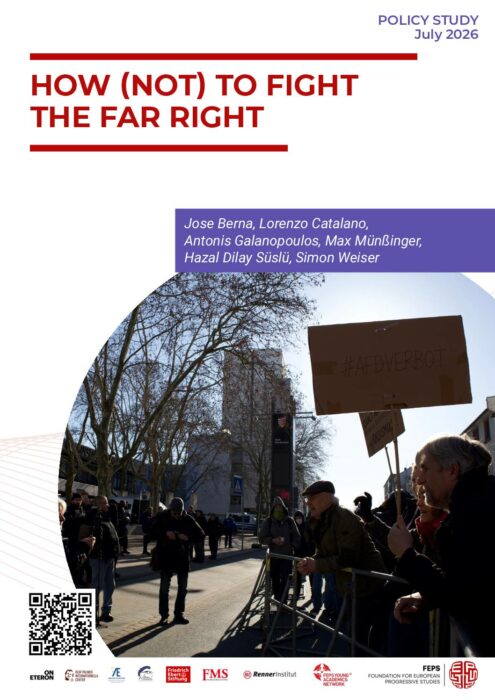
This policy study investigates the strategies employed by European social democratic parties in response to the rise of far-right political parties since the 2010s. By building on well over 100 academic studies, we draw clear strategic implications for progressive actors facing far-right competition.
After looking at scientific research on how to fight the far right, a minimum of three strategic orientations emerge:
1) Social democrats must systematically understand why far-right narratives resonate – examining social grievances, emotions and discursive strategies – without adopting far-right frames.
2) They must reclaim agenda-setting power by foregrounding areas of long-standing credibility – notably, welfare, redistribution and economic justice – and by refusing debates imposed on far-right terms.
3) Social democrats need a positive, forward-looking vision that combines an inclusive collective identity with a credible agenda for economic equality, reconnecting policy with collective emotions.
Read the Policy Study
Academic Mentor: Daphne Halikiopoulou, Professor of Comparative Politics at University of Reading
Political Mentor: Mathias Ecke, S&D MEP of the European Parliament